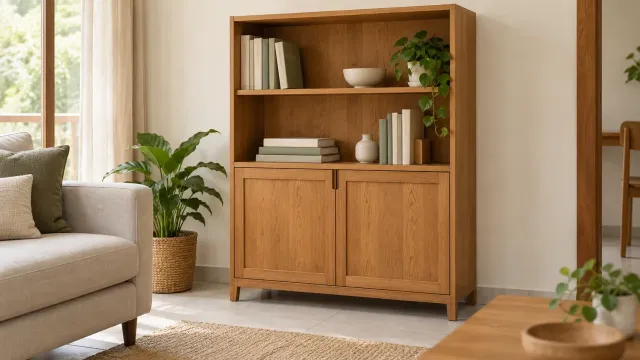
To choose living room storage, start with the items you need to store and how you retrieve them. Open shelving helps display books or collections, while a cabinet with doors conceals items with varied appearances. Combining both can be useful when the living room also supports family activities.
Group your belongings before choosing furniture
List the items that will actually go inside: books, documents, entertainment equipment, toys, or small supplies. Separate frequently used items from those you rarely retrieve, then decide which ones you want visible.
Do not choose the number of compartments from a photograph alone. Measure the largest items and check the clear internal dimensions. A cabinet's external size is not the same as the storage space remaining after panels, dividers, and hinges are accounted for.
When does open shelving work better?
Open shelving lets you see where things are without opening a door. It can help when the contents are easy to group and you are willing to tidy them regularly. However, items with different sizes, colours, and packaging will remain part of the room's appearance.
For example, a few books and a small collection can occupy separate groups. Leave room to retrieve books rather than packing the shelf so tightly that items are difficult to pull out. Check each shelf's load limit with its maker, especially before storing heavy books.
When is a cabinet with doors more useful?
A cabinet with doors can reduce the visual presence of packaging, spare cables, or supplies you do not want to display. Before buying, make sure the doors can open without hitting the sofa, table, or a walking route.
A cabinet does not make an unorganised pile easier to use. Give stored items clear groups so they remain easy to find. For electronic equipment, follow the manufacturer's ventilation and cable access requirements; do not enclose it simply to achieve a tidy appearance.
Consider a mix of open and closed storage
For mixed needs, assign a purpose to each section. For example, upper shelves might hold frequently read books, while a lower cabinet stores boxed family games. This is an example of functional organisation, not a rule that heavy objects are always safe in a particular section.
Test the plan with your actual belongings
Make a simple table listing each item, its size, how often it is used, and whether it needs to be visible. Match each group to an available compartment. If many items still lack a place, revise the storage plan before adding decorative accessories.
Check everyday use
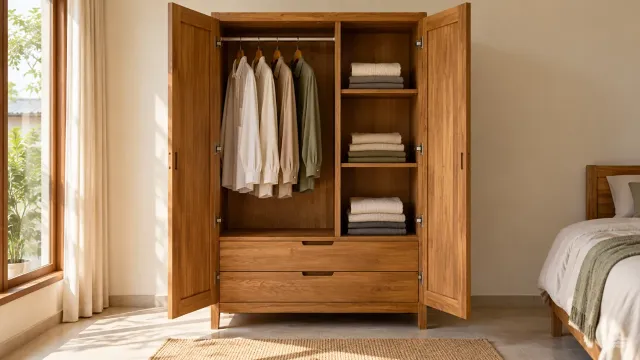
Try the motions of retrieving items while standing and sitting. Check whether drawers can extend fully and whether your hand can reach objects at the back. In a tight room, sliding doors can reduce the need for door swing space, although part of the opening usually remains covered when a panel is moved to one side.
Also consider access for cleaning beneath and behind the furniture. Ask about care suitable for its materials and finish rather than assuming that every surface can be cleaned with the same liquid.
Mistakes to avoid
Buying a cabinet simply because it has many doors, filling open shelves with every household item, and overlooking internal dimensions can all create inconvenient storage. Another mistake is treating a styled photograph as evidence of shelf capacity or strength.
Before ordering, confirm clear compartment dimensions, load limits, installation requirements, and the maker's securing instructions. The right storage suits your belongings and habits while preserving usable space in the living room.