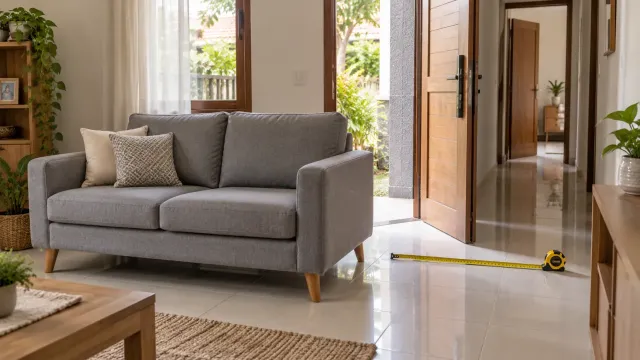
Before buying a sofa, measure the entire route from the vehicle stopping point to its intended position inside your home. Record clear doorway openings, turning space, and the sofa's delivery dimensions. A sofa that fits your living room may still be difficult to move through the entrance or a corner on the way.
Start with the sofa as it will be delivered
Ask for the length, depth, and height of the item in its delivery configuration. Check whether legs, backrests, or modules are actually designed to be removed and whether reassembly is part of the agreed service. Do not assume a component is removable simply because it has a visible joint.
For a modular sofa, record the dimensions of the largest individual modules. Packaging also takes up space. Ask whether the stated dimensions include packaging and who is authorised to remove it during delivery.
Record the route, not just the doorway
Walk along the route that will actually be used. Note each of these potential obstacles:
- Gates and the approach to the house.
- Clear doorway width and height with the door open.
- Corridors, corners, and the space immediately before and after a doorway.
- Stairs, landings, handrails, or lift doors where relevant.
- Pendant lights, fixed cabinets, and other objects that reduce manoeuvring space.
Measure the narrowest remaining space after allowing for frames, handles, and fixed obstructions. A door leaf's nominal width is not the clear opening available for moving furniture.
A simple example
Suppose you record a clear doorway width of 78 cm and a sofa depth of 85 cm. Those measurements call for further assessment; they do not automatically prove that delivery will fail or that tilting the sofa will work. Sofa height, item length, space on both sides of the doorway, and the ability to hold and rotate it also matter.
Send measurements and route photographs to the delivery provider. Ask for an assessment of the actual item being delivered, rather than a sofa with a similar shape.
Check corners and turning space
Even two reasonably wide corridors can make moving a long item around a corner difficult. Photograph the corner from both directions so that frames and fixed objects are visible. Include corridor measurements and the available space around the turn.
Masking tape on the floor can help you visualise the sofa's final position. However, a floor footprint does not prove that the item can turn through a three-dimensional route. For a complicated route, request a survey or technical confirmation from the delivery provider before completing the order.
Agree on the details before delivery
Create one record containing sofa dimensions, route measurements, obstacle photographs, and permitted access options. Include building management requirements, goods lift arrangements, or access times where applicable. Confirm these with the relevant parties instead of assuming that rules from another building apply.
Agree on who clears small objects from the route, who reassembles sofa components, and what happens if access proves unsuitable. Ask about charges or service changes before delivery day, without assuming every delivery includes the same work.
Mistakes to avoid
Common mistakes include measuring only the room, overlooking corners, estimating dimensions from photographs, and planning to dismantle components that are not designed to be removed. Do not plan to lift a sofa over a fence or through a window without appropriate professional handling.
A useful access check establishes two things: the sofa suits the room, and the entry route has been assessed using real measurements and conditions. Keep a shared record so that the buyer, seller, and delivery provider are discussing the same item and route.