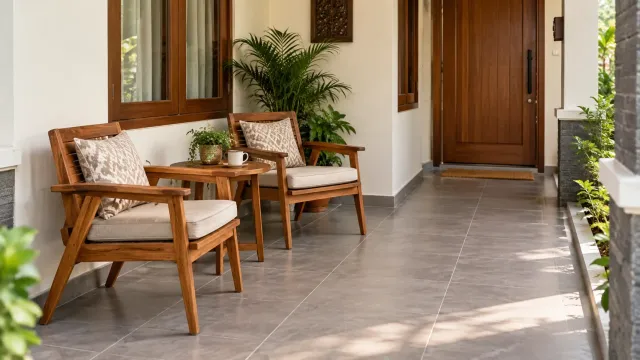
To arrange chairs on a small porch, identify the route from the garden or entrance area to the door first, then place seating outside that route. Choose the number of seats around the household's habits rather than the size of an attractive furniture set. Add a small table only when the door, users' legs, and everyday access still have enough room.
This guide helps you plan a seating area before choosing furniture. Final dimensions and arrangements should reflect your actual porch and the measurements of the products you are considering.
Start with the entrance route rather than chair positions
A porch often serves as both a seating area and the main entrance to a home. If you position chairs first, the remaining passage can feel cramped even when all the furniture fits on the floor.
Draw a simple plan and mark:
- the door position and the direction in which it opens;
- steps, columns, plant pots, and shoe storage;
- the usual route from outside into the house;
- areas exposed to wind-driven rain or direct sunlight;
- uneven flooring or places that frequently become wet.
Open the door as you would when carrying shopping bags. Notice the space used by the door and your body as you turn. Keep furniture out of that area. Do not treat the usable porch area as length multiplied by width alone: columns and the door opening reduce the available space.
Choose the number of chairs around everyday activities
Two chairs for short conversations
Separate chairs are worth considering when two people usually use the porch. Arrange them at a slight angle or facing each other if the porch is deep enough. Make sure users' knees and the table do not extend into the entrance route.
There is no need to force a face-to-face arrangement onto a shallow porch. Placing chairs alongside each other on the same side can be an alternative if conversation remains comfortable.
One chair for a personal sitting spot
When the porch also holds shoes, deliveries, and plants, one chair may suit it better than a complete set. Decide whether the seat is for reading, waiting for transport, or removing shoes. These activities help determine its location and access to the items used with it.
A bench for sitting together
Consider a bench when there is a sufficiently long wall and household members usually sit together. However, a bench does not automatically save space. Compare its width, depth, backrest, and legroom with separate chairs. Avoid arrangements that require one person to pass another seated user to reach the door.
Compare three simple layouts
Chairs alongside a wall: useful when the route to the door runs along the other side of the porch. Measure to the outermost part of each chair, including the backrest and arms. A seated person's legs also occupy space in front.
Two chairs forming a corner: can support conversation when an unused corner is available. Check that both seats can be used at once and that the arrangement does not block access to a window or plant pot.
One chair with a side table: an option when most of the floor needs to remain available for access. Put the table within reach without interrupting the passage. If it serves only as a display surface, consider leaving it out.
No single arrangement suits every home. Choose a layout that works while people are seated, rather than only when the furniture is empty.
Measure the whole item before buying
Ask for each chair's overall width, depth, and height, including projecting arms or backrests. For a table, check both the surface dimensions and the position of its legs. Product photographs alone cannot show how much usable space an item occupies.
Seat height, backrest shape, and armrests also deserve attention. If possible, try sitting in and standing up from a similar model. Different users may experience comfort differently, so porch dimensions are not the only consideration.
Browse the Centrova furniture collection in Indonesian, then request confirmation of the dimensions and intended use of any model you are considering. Do not assume that every wooden chair is suitable for an uncovered porch based on appearance alone; ask the seller about materials, finishes, and care instructions.
Simulate the arrangement before ordering
- Mark the outer dimensions of the chairs and table on the floor with paper or tape that will not damage the surface.
- Open the door fully and walk along your usual route.
- Use a chair you already own to try a seated position, leg placement, and the movement needed to stand.
- Repeat the exercise with two people using the seating area simultaneously.
- Put plant pots and shoe storage in their actual positions, then check access again.
For example, if the main entrance route runs along the right side of the porch, try placing seating on the left. If two chairs and a table force users' legs into the right-hand passage, move the table beside a chair or reduce the number of furniture items. This example illustrates how to compare options; it is not a universal minimum-space rule.
Commonly overlooked mistakes
- Buying a complete set without measuring each item. A central table may occupy the space needed to stand up.
- Measuring empty chairs only. The layout should account for users' legs and movements.
- Ignoring the door opening. Furniture can fit on the floor while still obstructing access.
- Adding too many plant pots. Leave room to care for plants without moving chairs every time.
- Judging outdoor suitability from wood species alone. Exposure conditions and the product's recommendations still need confirmation.
Questions about chairs for a small porch
Must a small porch have armless chairs?
Not necessarily. Armless chairs are an option, but compare overall dimensions and users' needs. A compact chair with arms may occupy less space than a wide armless model.
Does a table have to sit between two chairs?
No. A side table or a layout without a table may be more suitable when the entrance route takes priority. Keep frequently used items within easy reach.
What if the door opens onto the porch?
Mark the full door swing and the space needed to walk before deciding where chairs should go. Avoid arrangements that require furniture to be moved every time the door opens.
What should I prepare before asking for advice?
Gather the porch measurements, photographs from several angles, door-opening direction, number of users, and information about exposure to rain or sunlight. Include the dimensions of the furniture you are considering so that layouts can be compared concretely.
Start with a comfortable entrance route, then add only the seating you need. A small porch becomes easier to use when each furniture item has a clear purpose and its position has been tried before purchase.